Reckless Bunch

I carried with me the freshness of riding the L train from Brooklyn to Manhattan alone, the nerves from the unfamiliar responsibility that came with starting a more senior job after barely graduating and moving across the country, the uncertainty that came with the transition phase of staying with my parents in New York as my bed shipped to my studio apartment in Philadelphia, the fondness from a long-delayed catch-up over cauliflower pizza with an old college friend, and the closure that came from journaling for three hours in a coffee shop with a friend of a friend as she studied for her bar exam. Unfiltered, honest journaling honestly helped me accept it in a way nothing else had: anyone I had ever loved before was all the way back in California, a place I could no longer call my home, and I was never meant to be with them anyway – now that I had my degree under my belt, I needed to live my own life, feel new feelings that I so desperately wanted to feel after watching so many queer TikToks. As someone who gets a crush about once every two years only after age twenty-two, I knew I wasn’t going to find love so easily, but at least I could find a good story. Some tea to spill to entertain my friends. Something to giggle about.

I’d always dreamed of being like one of those gay femme girls in Zara Barrie’s stories; the glittery excursions in New York lesbian bars enticed me with their sharp contrast to the lonely, spread-out city of Los Angeles, where not a single lesbian bar survives, and the only gay coffee shop shut down during the pandemic. And here I was, heading to the famous Cubbyhole, about to meet a queer stranger from Hinge who had invited me out for drinks, and with my red polka-dotted dress, gold hoop earrings, and hot pink lipstick, I felt like I was finally crossing something off my bucket list. 

When the clock crept closer to eight o’ clock, the cauliflower crust seemed to weigh heavier in the pit of my stomach, and I dreaded leaving the comforting, familiar energy of an old friend to meet a stranger. “Well, I can make you really uncomfortable to convince you to leave,” she offered as I confided this sentiment in her, but it was a three-minute walk from the restaurant and I had zero expectations – I hadn’t even styled my hair, leaving it in its natural, wavy form. 

That dread was soon drowned out by the easy-flowing conversations, with an inexplicable familiarity as if she were already a friend or a friend of a friend, as we discovered never-ending fractals of common interests, career goals, favorite media, and opinions, abandoning Cubbyhole to walk to a dessert shop, exclaiming “men are trash” in response to the waiter asking her if she was single as I was returning from the restroom. As we parted with a hug and jumped onto the L train in opposite directions, mine heading to Brooklyn and hers to Jersey, I texted my friends that I felt like I had at least made a potential new friend, daresay we had chemistry, but it was too early to tell, until I received that text confirming that she had a nice time, apologized for the awkward goodbye (I hadn’t noticed) and she wanted to tell me that my eyes were gorgeous. The next day, as I finally moved into my apartment in Philly, she double texted following up about the podcast we’d discussed, Normal Gossip, saying she had caught up on all the episodes I’d cited as my favorites, and thus began over a month of regular correspondence, with increasingly lengthy, increasingly emotionally vulnerable text paragraphs, pulling out of the depths of my brain stories about my childhood, my mother, my tense and painful relationship with my close family friends, things that I had never told any of my friends because no one had ever asked with such patience and deep interest before. I didn’t want to put too much pressure on the connection, but it was impossible not to place this one on a high pedestal over the others, and I had spent so many months, years, not feeling anything and emotionally shielding my deepest layers from friends out of fear of falling for people who might not even be into women. I decided to knowingly assume the risk, canceling all my dates with people who had actually labeled our meetings as “dates” in exchange for the thrill of the uncertainty of these “hangouts” and emotionally charged texts and music and poetry exchanges. 

I shared with her my poem about feeling like a moth among butterflies, both due to my body image issues as well as my internalized homophobia and trauma and how intertwined those things were, and she shared with me a similar poem about feeling like a weed among flowers, and how it made her feel alone. Feeling alone was something I was deeply familiar with, and I marveled at my luck of finding someone who was stirring in me the feelings I had been longing for but were so rare for me. I felt a thrill of anticipation of the potential of connecting with someone who could understand all these broken parts of me and still choose to accept me, because those feelings weren’t foreign to her.

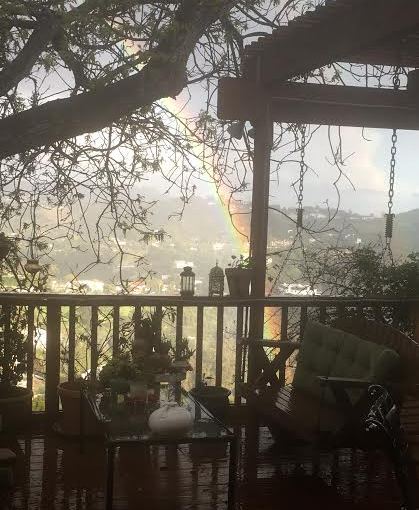
The text paragraphs became a part of my new routine in Philadelphia, walking across the river to campus with headphones in my ears listening to her music recommendations and spending my evenings walking around the local square park, grinning ear to ear at her name on my phone screen when her texts came in and listening to nostalgic favorites as I mulled over what she had said and considered my responses. The adrenaline of our almost canceled plans because my car got towed, her moving around her lab schedule to accommodate seeing me, her specific compliments about my coordinated outfit and the way my hair framed my face, the walk through the blaring sun, followed by sudden, pouring rain, followed by sun again and the subsequent rainbow that appeared in our frame of vision as we walked back through the lawns to her apartment that seemed a confirmation of her interest and the universe’s acknowledgement of the specialness of this connection. I thought of her as I made the decision to drive an hour to the YMCA in the suburbs of Pennsylvania, as it was the only one nearby that had a synchronized swimming program, inspired by her commitment to her analogous niche interest, pole dancing, and consulted her before making my own decision about whether to pursue it longer term. I thought about my excitement as I drove through the beautiful windy roads paved through gleaming greenery that was unheard of in California. The leaves seemed to shine in the summer light with a beauty I would have never noticed if I weren’t so intoxicated with dopamine spikes, and all the time I had spent in Los Angeles, driving through the true-to-stereotype horrendous traffic to awkward queer events and boring dates, trying to force feelings that weren’t there and trying not to feel resentment for my friends who were getting married to their best friends…it all suddenly felt worth it, because maybe I didn’t have to feel the pain of that loneliness anymore. Maybe it was the rareness of a connection like this that made it so special. 

I wasn’t in love, because I barely knew her, and I wasn’t thinking that far into the future, but she was the first one in a long time to make my heart feel anything, to remind me that I wasn’t broken by my past and that I could still feel deeply. I didn’t find love, but I found the willingness to confront the part of me that wants what doesn’t want me – well, at least not in the same way. She might have wanted me, but not in the way that I wanted her, not as someone to connect to, to share with, to face our pain together and uplift each other through the other parts of life that were hard. She was also in pain, but she didn’t want connection. She wanted control. She wanted to see if she could claim me as another prize in her collection of trophies that made her feel chosen. 

She was comfortable in her own skin and body in a way that I could only dream of, comfortable expressing herself through pole dancing – she knew she was attractive, and she wasn’t afraid to express it through her art, her body like a paintbrush and the pole like a canvas. I admired that part about her, but it was more the sentimental texts and poetry that had sparked my interest. There was a shift in our correspondence after she’d sent me some music that she acknowledged was different from the sentimental R&B singer-songwriter favorites that we shared – it had, well, more of a sexually charged vibe. She told me she was curious to know what I would think of this music because it was different. What followed was a question about a book on asexuality she had seen on my Goodreads. She asked how I identified, and I answered honestly, that I identified as on the asexual spectrum, as demisexual, as someone who needed to develop an emotional connection before feeling sexual attraction and preferred to take things slow. My admittance was followed by a two-day silence, a weekend where I tried to distract myself with excursions to the Hindu temple and a uniquely excellent Italian restaurant with new friends in Philly but ended up oversharing my anxiety with them. “If it’s meant to be, he’ll respond,” they tried to soothe me, though their assumption about my sexuality only made me feel more alone. Her late response, a first for our previously steady correspondence, confirmed what I had a nagging suspicion of – she wasn’t the person I was hoping for. She was not ready for the type of connection I wanted. She was still exploring her sexuality, trying to regain control and reclaim her power from past wounds. She was enticed by the idea of having multiple intimate connections while remaining single and free from the possession of any one person. I expressed support for her journey and made a vow to myself to seek the connection I was craving from sources that were more compatible with me.

Our last hangout, initiated by her, accepted by me after two weak attempts to postpone, accepted against the advice of my caring, wiser and more experienced friends, took place in my neighborhood in Philly. Boundaries reconstituted, we met as friends, without the usual greeting and parting hugs, brought takeout mac and cheese flights up to the rooftop of my apartment with a view of the beautiful Philadelphia skyline before hanging out in my studio on the floor next to my bed with my dog, my flashing rainbow fairy lights, and fruity kombucha in wine glasses. To hammer in the boundary of us being friends, I brought to the conversation my dates with other people, overblown, as I knew that I had ended all these connections after the first date due to the lack of a click. During our subsequent excursion to a rooftop bar in the gayborhood of Philly, the drinks were flowing, and we gossiped and giggled as friends – until a pang hit me as she described the many other people she was connecting with in a way that I know never would have affected me with someone who was truly just a friend. I blamed my silence on the alcohol as she opened her Hinge in front of me and asked my opinion on the profiles of women who had liked her, claiming that sometimes she just engaged with people she didn’t care for because she liked the attention. “Like, please tell me I’m pretty,” the drunken admittance pierced me, as I wondered if that’s how she felt when I told her that I noticed the way she had chosen a perfect shade of red eyeshadow that matched her hanging red earrings, or admitted that I’d always been attracted to women with dark eyes (she had dark eyes), in contrast to my own lighter ones, because they felt so deep and mysterious. 

Was she looking at me with pity, with smugness in capturing the romantic affection that my heart reserved for so few individuals? Was she aware of the feelings she was stirring in me as she asked, before we parted, “by the way, since we were talking about Hinge back in the bar, I’m curious, are you seeing anyone right now? Wow, I’m turning red.” When I asked her why she wanted to know, she clarified that her curiosity was just for the gossip. Suddenly, I remembered how she’d told me that the flashing rainbow fairy lights in my bedroom were too overstimulating, the same fairy lights that had soothed me through my most stressful moments. How when we discussed my favorite episode of the podcast Normal Gossip, the one about the queer women’s kickball league, we’d identified with characters on complete opposite ends of the spectrum. While I related most to the protagonist, Lucy, because of her feelings of frustration in finding a connection in the small world of queer women, and her unrequited crush on her teammate, Rory (though through the twists and turns of the plot, they ultimately end up together) – well, she had never envisioned herself as Rory, but rather she identified with Mel. Mel, the only girl on the team who was an ultra femme, the one who everyone wanted because she was hot. The one who Rory and her girlfriend Jada opened their relationship for, the one they both fell for – but to Mel, their connection was just casual. 

How had I read her so wrong? How did this fit in with the woman she showed me through her poem, the one who pictured herself as a weed among flowers, the one I thought was just like me? The one who feared that she wasn’t beautiful enough to be loved, but found peace in having more to give to others and alleviate their pain, just like I did, but with her pursuit of me, double texts when I didn’t respond, and consistent words and actions and effort to come to see me and move her schedule for me, I hardly expected her to be the one to confirm that fear for me even more deeply. 

“Paheli, people who use people like that and mistreat people they’re not interested in are almost always overcompensating for a deep insecurity,” my wise friend had told me over the phone as I relayed the whole story. “Why would people who like themselves ever treat others so poorly?” 

A part of me yearns to reach out to her, to try to alleviate her pain, but the other part warns me not to get too close, even as a friend, not to stick around and watch her love other women the way she never loved me, to project onto these unsuspecting women my unfair envy, my unjustified comparisons. My overthinking, childish, racing thoughts about how if only I were as pretty (read: thin) as them, maybe I would be good enough to be one she loved – even though I cognitively know that it is as impersonal as a song that stirs my deepest emotions falling on indifferent ears in my brother. It doesn’t change the inherent worth of the song one bit, and I know I won’t feel like I’m asking for too much from someone whose heart matches mine, who wants the same things as I do. And I’m now wise enough to understand that her pain was never mine to carry. 

They say that grief is just love with nowhere to go. I know what I felt for her was never love, because love does not seek to possess someone who doesn’t want to be possessed. But I know it had the potential to grow into love, and since it will never happen, I grieve. I grieve for the girl who only ever wanted to feel understood and loved by someone she could also love, and how that feels so elusive while it looks easy to others. For the little girl who spent years of her adolescence suppressing who she really is because her feelings aren’t what society deems “normal.” For the girl in her early twenties who had to hold it all in and be strong for others, who blamed herself for the actions of a man. The woman who always only received the message that her feelings were too much, who doesn’t feel deserving of love because she’s never experienced it, whose own mother told her she was more beautiful when she starved and purged herself. The woman who feels shame for wanting it, even though craving love and connection is only human. We are not built to go through it all alone.

It feels lonely to realize that I can never express my grief to her because she will never understand it. To her, my grief would seem, at best, cringy, and at worst, deeply uncomfortable. I know that if I allowed it, she might still speak to me regularly, giving me just the right amount of attention and emotional validation I’ve always craved from someone I’m attracted to, making my face light up with every text the way no one else’s I’ve met since has, but I had to make the hard decision of setting a boundary for myself because I know it would be settling for less than what I want out of loneliness. Staying friends, at least so soon, is a bad idea – friends are people you should be able to express yourself to and be yourself with. Moreover, maybe I don’t want to be friends with someone where I’m unsure of their intentions with me, whether they respect me or speak about me behind my back in the same degrading way they speak about others. Maybe it’s okay to decide I don’t want that, that my own well-being comes first, while still wishing her the best and respecting her journey through her pain from afar. 

My favorite song she showed me was “Keys” by Meera. It speaks of how it makes the most sense, as the sole owner of a heart, to protect it and keep it safe, but we are a reckless bunch and we decide to give it all away anyways. The irony of her sending me this song as I decided to let her into my private space, something I rarely do, against my better judgment, was not lost on me. But I don’t regret it, because that’s what I was asking for. Just a story, just some feelings. I know that the leaves were shining brightly and the music sounded magical because of me, not because of her. And if I can still feel it after the deep trauma of my past, I think my heart can survive after a more simple unrequited crush. Moreover, I never shied away from facing the rejection of this connection head-on, without trying to conceal my interest, while maintaining respect for myself, and I think that’s a signal of my new willingness to be emotionally available. What she chooses to do with the knowledge of my feelings is her business, not mine, even if that choice is seeing it as just another conquest. I made it clear that I wasn’t going to participate in any power play games. Moreover, this experience has made me feel closer to my straight friends from college, grad school and synchro, with a newfound understanding of their experiences with men. I feel like I have been through a rite of passage of womanhood. It shocks me every time I realize how our experiences aren’t always so unique. 

I take solace in the fact that as much pain as I’ve felt, I’ve always made it a point to use that pain as fuel to try to heal others and not to hurt or use them. I feel sorry for people who turn cold and close their hearts, because I know that as much it can hurt, keeping a soft and open heart is what makes living feel so magical. I understand the power and strength of my softness, even if others don’t see it, and for that, I respect myself.
Spilling the Tea: Born This Way

CW: Internalized Homophobia

I grew up trying to please, sitting criss-cross-apple-sauce with my back upright and ready to hang on to every word that came out of my teacher’s mouth. When I asked my mom if I could marry a woman – after all, the curly-haired British twins in our class had two moms – she told me that women didn’t usually marry other women, because if there was no man they would never be able to carry the groceries into the house. Because marriage was between a man and a woman, I was reminded time and time again as my mom squealed words of disgust when the TV showed two women kissing on the lips, or when my uncle said that Netflix should get rid of their Lesbian and Gay genre because it would influence the kids.

But they didn’t have to worry about me, because I was a good girl, I was taking AP classes and didn’t waste my time on frivolous things like hanging out with friends or going to after school peer support groups, because I was busy studying, of course. I wore clothes that covered my legs and pretended that cramps didn’t hurt and counted calories and straightened my long, dark hair every day, because I was a good girl, not like those rebellious girls who would bleach their hair and chop it short and burn their skin with tattoos and eat what they wanted and talk about what they really felt. I chose to be a good girl. I chose not to be gay.

I still remember when my friend and I spent the whole Sunday afternoon at her place, painting our nails and curling our hair as she confided in me about the boys in her life. When it was my turn to share, and when I showed her a journal entry I had written about losing someone I considered one of my closest friends in high school. I remember her peals of laughter as she read, each one like a slap in the face. “It sounds like she was your boyfriend and you guys just broke up or something!” she shrieked in between fits of giggles, and I pretended to laugh along with her, as if I had written the whole thing ironically, as if I didn’t know deep down that I was in love with her and that was the real reason we couldn’t be friends anymore. From that day I understood that sharing the real me was like that recurrent nightmare where you’re stuck standing in front of a crowd of people naked, vulnerable, and exposed.

When I was twenty, my uncle asked my parents if they should start looking for a man for me. They seemed to have already planned out a ten day, elaborate wedding in Jaipur with camels and obnoxiously shrill flutes and intoxicated uncles and aunties. When I came back to visit my high school friends and the only thing I could share about my college experience was school, they told me that they needed to find a man for me. When I tried to tell my mom that I might be only attracted to women, she told me that I was just going through a phase, that I was too young to know my romantic orientation for sure. I was twenty-two years old.  For the longest time I felt that the only way to please the people around me was to find a boyfriend like all the other girls around me. I tried to choke back the revulsion at the thought of being intimate with a man. I tried to convince myself that was what I wanted.

It wasn’t until I was in my last term of college that I began to wonder why I cared so much about making other people happy and why I wasn’t extending the same kindness to myself. I realized that if I didn’t take care of myself, no one else would. I realized that it was okay to say no to things that I didn’t want to do, and I didn’t have to put up with people who brought me down rather than building me up. I didn’t have to try so hard to protect the feelings of people who didn’t think twice about mine. I will apologize if I say or do anything that hurts someone else, but I will no longer apologize just for being who I am.

Sometimes I wonder if my process of coming out would have been easier if there was someone in my early life to tell me that sometimes girls like girls and boys like boys and some people like both girls and boys, and some people are born with a set of chromosomes that don’t match their identity, and that all of these people are simply born that way, not because they chose to be rebellious or promiscuous. Or that sometimes you might love someone with all your heart and they will never feel the same way, but that doesn’t mean there’s anything wrong with you – all it means is that they aren’t meant for you. That feelings of attraction are natural, normal, and feeling them towards a woman doesn’t make you any less of a woman, or less beautiful, or less deserving of love and acceptance for who you are and not for who others want you to be. That there are women out there who might have the same feelings for you that you have for them, but that there’s no rush to try to find a partner, and it’s okay to devote time to caring for yourself and investing in your future. These were the things I wished someone had said to me, and the things that I am finally learning to say to myself.

April 2019 Grad School Life Updates

I originally planned to update this blog every week or so during school, but as soon as the quarter started, things got super busy and it was easy to put this off. Hopefully, I will be better about it this quarter!

To give some background, ever since I started thinking about applying to grad programs, I knew that I wanted to come to my school and program, Biomathematics. I did a lot of research on different aspects of the programs, and even more after I was invited to the interview weekends. I chose this place based on a lot of factors, including academic fit, future goals, advisors, general feel of the program, location, and LGBTQ+ friendliness of the campus.

The program has been wonderful so far and has even surpassed my expectations. It is a pretty tiny program, only 15 grad students total, so the classes are very small and everyone in the program knows each other. Every Thursday, the grad students, some of the students who work for our professors but are from neighboring departments such as Math and Biostatistics, and postdocs all go to a nearby bar, Barney’s, for “pub night”, where they basically drink beer, spill (metaphorical) tea, and relieve stress. In my experience with the students, they have all been incredibly helpful, friendly, and inclusive. I have been careful about sharing personal information with them and thus have only come out to one person in my program so far. I hope that I can make closer friendships with the other students over time.

IMG_0054

Grad school classes have been an adjustment in a lot of ways. On one hand, there is a lot more material covered per class – there have been times when the entirety of a math class I had taken in undergrad was covered in just two lectures. Moreover, it is impossible to get all the required background simply from attending class, and it’s necessary to do a lot of extra reading. One thing that has been surprising for me is that in my program’s core courses, as well as the neuroscience course I took, it didn’t seem as difficult as it was in undergrad to get good grades (despite the material being a lot more daunting). I think this is probably because in undergrad, there were more tricks on exams that were designed to weed people out, and now, the focus is on learning, asking questions that may or may not have answers, and being self-motivated to seek extra references for more information, but we aren’t being directly or comparatively evaluated for those things.

Another difference is that there is a lot more emphasis on reading papers and critical thinking, such as proposing potential experiments or critically examining the presentation of data and results in published papers. Some of my core biomathematics courses had homework problems that had no analytic solutions, or that there were multiple possible approaches, and the professors just wanted to see us come up with ideas, defend our assumptions, and solve as far as analytically (or numerically) possible. This is obviously quite different from undergraduate mathematics or chemistry classes, where there are standard solutions to most classical problems either in the back of the book or somewhere on the internet! But I suppose it is moving more reflective of problems in research that have not been previously solved.

I have particularly enjoyed the aspect of courses that involve choosing papers to review for final presentations, and it has allowed me to explore applications of mathematics and computation to neuroscience and has made me more excited about research. When I was in undergrad, although I studied in a theoretical physics group that looked at neuron dynamics, I wasn’t sure if I was doing it only because that was the main opportunity that came my way, but not out of real passion. I think I was too stressed about the prospect of grad school at the time to really develop my passion in research. However, I have always found myself drawn to related topics for class projects and during our department seminars. Biomathematics is a broad field, and I was originally considering exploring the statistical genetics route that is popular in my department, but after starting here, I think that my interests truly lie in neuroscience and mathematical physics, and I am now much more certain in choosing my research focuses and courses.

My department has many course requirements (4 core biomath courses, 2 biomath electives, 6 applied math courses, and 6 biology courses), and as a result, unlike some of the more experimentally focused departments like biology and engineering, they encourage us to focus on coursework and passing the qualifying exams during the first year. We don’t have official research rotations, and we don’t have to decide on an advisor until the end of the second year. However, all of my classmates have started working with potential advisors.

Although I unofficially attended research meetings in fall quarter, this winter quarter was my first official quarter of directed research. At the same time, one of my core courses was taught by my potential advisor (or PI, although my friends who are not in science keep thinking I mean “private investigator” when I use that term). He was an amazing lecturer; he wasn’t the kind of professor who continuously spews information while we furiously try to scribble everything down, but he led us to certain ideas by asking questions. One thing I really like about working with him, both through the course and during the research meetings and updates, is that although his work is clearly mathematically oriented (his background is in particle physics – interestingly, just like my PI in undergrad), unlike a lot of mathematicians and physicists, he has a very conceptual and biologically relevant approach. Some people in our program prefer more mathematical rigor, but for me, it seemed to be a perfect blend.

My advisor has done a lot of previous work on cardiovascular networks and the scaling of radius and length of individual vessels across levels of the network. I came to visit him before applying to the program, and when I told him that I was interested in neuroscience, he said that he could imagine the possibility of applying the same methods of analysis to study neuronal networks. Since I came to the group, I have been working on formulating this problem, solving for scaling ratios using Lagrange multipliers (more details about this method in my First Quarter Research Progress post), and analyzing data, both from images and quantitative data from 3D reconstructions of neurons. I have reformulated this problem so that instead of minimizing the power loss due to dissipation, I am minimizing conduction time. For neurons, one of the major evolutionary driving factors is the speed in conducting signals. For example, if you touch something hot like a stove, it would be helpful to have this sensory information relayed as soon as possible so you can pull your hand away before burning it! I have also been reading some papers from the fifties about conduction velocity in neurons and the effects of myelination (fatty layers that provide insulation for nerve fibers) on this speed, and have recently incorporated the degree of myelination as a parameter. I am also looking to modify the space filling constraint to fit neuronal systems, but I am not quite sure how to do this yet. Taking neuroscience courses concurrently with this project is helpful because sometimes I will get random ideas from class that I might be able to translate to math in a way that I can incorporate it into my model. Sometimes, I watch videos of talks by researchers in biology about dendritic morphology and structural neuroscience and feel somewhat overwhelmed, because I am obviously making a lot of simplifying assumptions and not taking into consideration factors such as genetic influences.

Overall, although research is messy and involves a lot of seeking information from various fields, as well as catching up on basic electrodynamics, fluid mechanics, and neuroscience that I never learned in a class, I am enjoying it a lot. This is my first time having my own project, as in undergrad I was for the most part working as a minion, completing menial coding tasks for grad students’ projects. My office mate in my undergrad research group, now a fourth-year grad student in the same group, came to visit me over spring break and told me I seemed a lot more confident than I was last year. Which is strange to me because I feel more overwhelmed and confused the more I learn! I suppose the “confidence” might come from accepting that I don’t know everything, or even a lot, and I’m more comfortable with being uncomfortable, if that makes any sense at all.

As I anticipated, making friends has been quite difficult for me in grad school. It was especially difficult in fall quarter, when I avoided going to LGBTQ+ specific events out of fear of the unknown, mostly, and just went to the weekly department pub nights every now and then, and spent the rest of my time shut up in my own room. My department mates are wonderful and lovely, but aside from the fact that I am not hugely into drinking, the conversations were centered around heteronormative romantic experiences, and I found myself feeling isolated a lot of the time – especially since I’m not out to most of them. When I talked to my mom about it over winter break, she suggested that I add queer org meetings to my schedule rigidly, with the same priority as classes, just so that I could feel more of a sense of community. I decided that this was a good idea, as mental health is an important thing to commit to.

In winter quarter, I regularly attended two queer orgs. One of these is called QSTEM, or Queers in STEM. It was founded by a second year PhD student in Geochemistry who identifies as a gay man. This org is mostly other graduate students, and the vast majority of them are men, which is not entirely unexpected. I have enjoyed participating in social events such as board game nights and ice cream socials. They also have a lot of outreach opportunities, which I hope I have time to get more involved in as my courses finish up and some time is freed up.

The second org I attended was called Queer Girl, and is only open to women and non-binary people. I was the only one there who wasn’t an undergrad, but was a nice social space to discuss things like queer representation in media (or the lack thereof, especially when it comes to women) – it gave me the opportunity to talk about Shay Mitchell in Pretty Little Liars and a random Korean webtoon I found called “Fluttering Feelings.” There’s definitely a lot I could learn from these women, as they would talk about their sexuality openly, which is something I’ve never been comfortable doing. Being around other women like me helped normalize my experiences a little. One of the coordinators of the group was a fellow Asian woman from San Diego (when I went to undergrad), and it was nice to meet someone I could vent to about missing San Diego and people always assuming we’re straight (being Asian/South Asian and having long hair is a surefire way to convince everyone you’re straight).

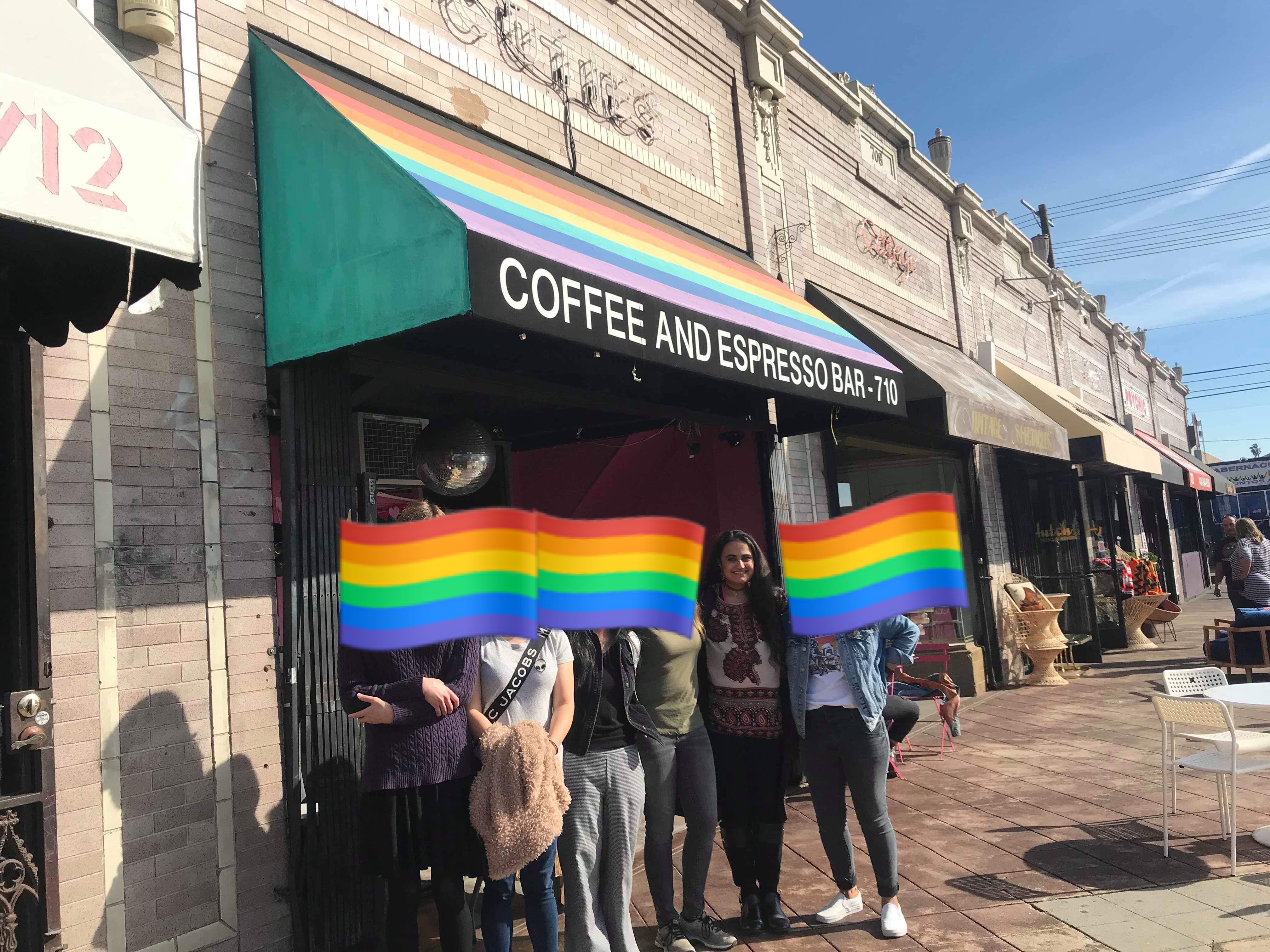
One of the social events in this club was a trip to Cuties Coffee, a queer owned and themed coffee shop in East Los Angeles that is designed to be a daytime, sober space for queer socialization and an alternative to the gay bars in West Hollywood. I loved visiting this place so much that I have now made it part of my weekend routine – I go there from around noon to four almost every Saturday to either study for classes or work on coding for research. I have included a picture from that day, and used the rainbow pride flag emojis to cover faces for the privacy of the other org members.

IMG_0079

I can’t stress how important it has been for me to have a queer sober space to go to, as I would say I’m pretty far on the introverted side of the spectrum and I never quite feel comfortable meeting new people in bars or nightclubs. (I still mostly keep to myself, drink my coffee/tea, and study during my trips to Cuties, but I hope I will cross the barrier of talking to strangers soon!). At the beginning of winter quarter, I went to West Hollywood a few times to check out the gay bars and nightclubs. Although I love walking on the main strip in West Hollywood, and enjoyed the experience to some extent, it’s not ideal for me because 1) the bars and clubs are largely catered towards gay men – Wednesdays are the only nights specifically for women, and there are no specific clubs for women, and 2) for some reason, being in these spaces where I’m (theoretically) approaching random strangers who are making snap judgments and impressions about me solely based on my physical appearance spiked some of my body insecurities, and to be honest, that’s not a headspace I want (or need) to be in. Right now, the focus for me is on meeting new queer friends and building community, and I’m grateful for these multiple sober spaces I have had access to this quarter.

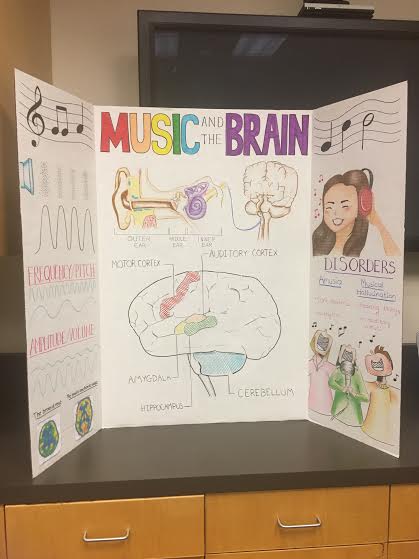
Another extracurricular activity I participated in this winter was a club that does educational outreach in the form of presenting posters about various neuroscience to elementary through high school students to get them excited about learning about the brain. I was part of this Committee called Project Glia, which is responsible for designing and creating posters. I really wanted a way to keep in touch with my art – it can be extremely cathartic and rewarding, and I also want to catch up on the neuroscience background I never had in undergrad for my research, so this was the perfect opportunity for me. I designed this poster for “Music and the Brain”, and I was working with two undergrads who did a lot of the neat typography and shading. The director of Project Glia is a senior undergrad who happens to be taking one of my current graduate neurosciences classes with me, The Biology of Learning and Memory.

0-2

One thing I found strange in participating in these activities is that sometimes the undergrads I interact with seem to look up to me in a way, or think that I know things because I am a grad student. One of the students was talking to me the other day about imposter syndrome and comparing yourself to other people, and I ended up saying something along the lines of “Oh, I totally understand that feeling because I used to do that too. But honestly, you can drive yourself crazy comparing yourself to other people – I know because I have done it too, but I realized it was no longer serving me, and I realized I don’t have to be this ‘star student’ to still enjoy what I’m doing.” “That’s SO true,” she had responded sincerely, and meanwhile I was internally panicking during this entire interaction. It was different than listening to a friend, someone who considers me a colleague, and I was suddenly aware of the power dynamic and how much responsibility I had. I think because I’m currently a woman in a grad school program in a related field, some of these women who have goals of grad or med school see me as a sort of safe person to vent to who knows what it’s like to go through this kind of application process and how demoralizing it can be. I was quite nervous about saying the right thing, and having the right mix of relatability and encouragement – all without sounding too preachy or pretentious. When I talked about this later at pub night later with a sixth-year in my program, someone who has significant teaching experience, he reiterated that I have the power to reduce these young women’s imposter syndrome in STEM simply by listening to them and encouraging them. Which is exciting, but also intimidating, because just a year ago, I was that undergrad.

Anyways, that is the (long-winded) gist of the updates of my grad school life over the past quarter. I have some ideas for future, more focused posts, but hope to update more often with these topics as they come up! Until then, I have an exam coming up in my cell neurobiology course, a data analysis assignment, and a research presentation coming up. Wish me luck!