Reckless Bunch

I carried with me the freshness of riding the L train from Brooklyn to Manhattan alone, the nerves from the unfamiliar responsibility that came with starting a more senior job after barely graduating and moving across the country, the uncertainty that came with the transition phase of staying with my parents in New York as my bed shipped to my studio apartment in Philadelphia, the fondness from a long-delayed catch-up over cauliflower pizza with an old college friend, and the closure that came from journaling for three hours in a coffee shop with a friend of a friend as she studied for her bar exam. Unfiltered, honest journaling honestly helped me accept it in a way nothing else had: anyone I had ever loved before was all the way back in California, a place I could no longer call my home, and I was never meant to be with them anyway – now that I had my degree under my belt, I needed to live my own life, feel new feelings that I so desperately wanted to feel after watching so many queer TikToks. As someone who gets a crush about once every two years only after age twenty-two, I knew I wasn’t going to find love so easily, but at least I could find a good story. Some tea to spill to entertain my friends. Something to giggle about.

I’d always dreamed of being like one of those gay femme girls in Zara Barrie’s stories; the glittery excursions in New York lesbian bars enticed me with their sharp contrast to the lonely, spread-out city of Los Angeles, where not a single lesbian bar survives, and the only gay coffee shop shut down during the pandemic. And here I was, heading to the famous Cubbyhole, about to meet a queer stranger from Hinge who had invited me out for drinks, and with my red polka-dotted dress, gold hoop earrings, and hot pink lipstick, I felt like I was finally crossing something off my bucket list. 

When the clock crept closer to eight o’ clock, the cauliflower crust seemed to weigh heavier in the pit of my stomach, and I dreaded leaving the comforting, familiar energy of an old friend to meet a stranger. “Well, I can make you really uncomfortable to convince you to leave,” she offered as I confided this sentiment in her, but it was a three-minute walk from the restaurant and I had zero expectations – I hadn’t even styled my hair, leaving it in its natural, wavy form. 

That dread was soon drowned out by the easy-flowing conversations, with an inexplicable familiarity as if she were already a friend or a friend of a friend, as we discovered never-ending fractals of common interests, career goals, favorite media, and opinions, abandoning Cubbyhole to walk to a dessert shop, exclaiming “men are trash” in response to the waiter asking her if she was single as I was returning from the restroom. As we parted with a hug and jumped onto the L train in opposite directions, mine heading to Brooklyn and hers to Jersey, I texted my friends that I felt like I had at least made a potential new friend, daresay we had chemistry, but it was too early to tell, until I received that text confirming that she had a nice time, apologized for the awkward goodbye (I hadn’t noticed) and she wanted to tell me that my eyes were gorgeous. The next day, as I finally moved into my apartment in Philly, she double texted following up about the podcast we’d discussed, Normal Gossip, saying she had caught up on all the episodes I’d cited as my favorites, and thus began over a month of regular correspondence, with increasingly lengthy, increasingly emotionally vulnerable text paragraphs, pulling out of the depths of my brain stories about my childhood, my mother, my tense and painful relationship with my close family friends, things that I had never told any of my friends because no one had ever asked with such patience and deep interest before. I didn’t want to put too much pressure on the connection, but it was impossible not to place this one on a high pedestal over the others, and I had spent so many months, years, not feeling anything and emotionally shielding my deepest layers from friends out of fear of falling for people who might not even be into women. I decided to knowingly assume the risk, canceling all my dates with people who had actually labeled our meetings as “dates” in exchange for the thrill of the uncertainty of these “hangouts” and emotionally charged texts and music and poetry exchanges. 

I shared with her my poem about feeling like a moth among butterflies, both due to my body image issues as well as my internalized homophobia and trauma and how intertwined those things were, and she shared with me a similar poem about feeling like a weed among flowers, and how it made her feel alone. Feeling alone was something I was deeply familiar with, and I marveled at my luck of finding someone who was stirring in me the feelings I had been longing for but were so rare for me. I felt a thrill of anticipation of the potential of connecting with someone who could understand all these broken parts of me and still choose to accept me, because those feelings weren’t foreign to her.

The text paragraphs became a part of my new routine in Philadelphia, walking across the river to campus with headphones in my ears listening to her music recommendations and spending my evenings walking around the local square park, grinning ear to ear at her name on my phone screen when her texts came in and listening to nostalgic favorites as I mulled over what she had said and considered my responses. The adrenaline of our almost canceled plans because my car got towed, her moving around her lab schedule to accommodate seeing me, her specific compliments about my coordinated outfit and the way my hair framed my face, the walk through the blaring sun, followed by sudden, pouring rain, followed by sun again and the subsequent rainbow that appeared in our frame of vision as we walked back through the lawns to her apartment that seemed a confirmation of her interest and the universe’s acknowledgement of the specialness of this connection. I thought of her as I made the decision to drive an hour to the YMCA in the suburbs of Pennsylvania, as it was the only one nearby that had a synchronized swimming program, inspired by her commitment to her analogous niche interest, pole dancing, and consulted her before making my own decision about whether to pursue it longer term. I thought about my excitement as I drove through the beautiful windy roads paved through gleaming greenery that was unheard of in California. The leaves seemed to shine in the summer light with a beauty I would have never noticed if I weren’t so intoxicated with dopamine spikes, and all the time I had spent in Los Angeles, driving through the true-to-stereotype horrendous traffic to awkward queer events and boring dates, trying to force feelings that weren’t there and trying not to feel resentment for my friends who were getting married to their best friends…it all suddenly felt worth it, because maybe I didn’t have to feel the pain of that loneliness anymore. Maybe it was the rareness of a connection like this that made it so special. 

I wasn’t in love, because I barely knew her, and I wasn’t thinking that far into the future, but she was the first one in a long time to make my heart feel anything, to remind me that I wasn’t broken by my past and that I could still feel deeply. I didn’t find love, but I found the willingness to confront the part of me that wants what doesn’t want me – well, at least not in the same way. She might have wanted me, but not in the way that I wanted her, not as someone to connect to, to share with, to face our pain together and uplift each other through the other parts of life that were hard. She was also in pain, but she didn’t want connection. She wanted control. She wanted to see if she could claim me as another prize in her collection of trophies that made her feel chosen. 

She was comfortable in her own skin and body in a way that I could only dream of, comfortable expressing herself through pole dancing – she knew she was attractive, and she wasn’t afraid to express it through her art, her body like a paintbrush and the pole like a canvas. I admired that part about her, but it was more the sentimental texts and poetry that had sparked my interest. There was a shift in our correspondence after she’d sent me some music that she acknowledged was different from the sentimental R&B singer-songwriter favorites that we shared – it had, well, more of a sexually charged vibe. She told me she was curious to know what I would think of this music because it was different. What followed was a question about a book on asexuality she had seen on my Goodreads. She asked how I identified, and I answered honestly, that I identified as on the asexual spectrum, as demisexual, as someone who needed to develop an emotional connection before feeling sexual attraction and preferred to take things slow. My admittance was followed by a two-day silence, a weekend where I tried to distract myself with excursions to the Hindu temple and a uniquely excellent Italian restaurant with new friends in Philly but ended up oversharing my anxiety with them. “If it’s meant to be, he’ll respond,” they tried to soothe me, though their assumption about my sexuality only made me feel more alone. Her late response, a first for our previously steady correspondence, confirmed what I had a nagging suspicion of – she wasn’t the person I was hoping for. She was not ready for the type of connection I wanted. She was still exploring her sexuality, trying to regain control and reclaim her power from past wounds. She was enticed by the idea of having multiple intimate connections while remaining single and free from the possession of any one person. I expressed support for her journey and made a vow to myself to seek the connection I was craving from sources that were more compatible with me.

Our last hangout, initiated by her, accepted by me after two weak attempts to postpone, accepted against the advice of my caring, wiser and more experienced friends, took place in my neighborhood in Philly. Boundaries reconstituted, we met as friends, without the usual greeting and parting hugs, brought takeout mac and cheese flights up to the rooftop of my apartment with a view of the beautiful Philadelphia skyline before hanging out in my studio on the floor next to my bed with my dog, my flashing rainbow fairy lights, and fruity kombucha in wine glasses. To hammer in the boundary of us being friends, I brought to the conversation my dates with other people, overblown, as I knew that I had ended all these connections after the first date due to the lack of a click. During our subsequent excursion to a rooftop bar in the gayborhood of Philly, the drinks were flowing, and we gossiped and giggled as friends – until a pang hit me as she described the many other people she was connecting with in a way that I know never would have affected me with someone who was truly just a friend. I blamed my silence on the alcohol as she opened her Hinge in front of me and asked my opinion on the profiles of women who had liked her, claiming that sometimes she just engaged with people she didn’t care for because she liked the attention. “Like, please tell me I’m pretty,” the drunken admittance pierced me, as I wondered if that’s how she felt when I told her that I noticed the way she had chosen a perfect shade of red eyeshadow that matched her hanging red earrings, or admitted that I’d always been attracted to women with dark eyes (she had dark eyes), in contrast to my own lighter ones, because they felt so deep and mysterious. 

Was she looking at me with pity, with smugness in capturing the romantic affection that my heart reserved for so few individuals? Was she aware of the feelings she was stirring in me as she asked, before we parted, “by the way, since we were talking about Hinge back in the bar, I’m curious, are you seeing anyone right now? Wow, I’m turning red.” When I asked her why she wanted to know, she clarified that her curiosity was just for the gossip. Suddenly, I remembered how she’d told me that the flashing rainbow fairy lights in my bedroom were too overstimulating, the same fairy lights that had soothed me through my most stressful moments. How when we discussed my favorite episode of the podcast Normal Gossip, the one about the queer women’s kickball league, we’d identified with characters on complete opposite ends of the spectrum. While I related most to the protagonist, Lucy, because of her feelings of frustration in finding a connection in the small world of queer women, and her unrequited crush on her teammate, Rory (though through the twists and turns of the plot, they ultimately end up together) – well, she had never envisioned herself as Rory, but rather she identified with Mel. Mel, the only girl on the team who was an ultra femme, the one who everyone wanted because she was hot. The one who Rory and her girlfriend Jada opened their relationship for, the one they both fell for – but to Mel, their connection was just casual. 

How had I read her so wrong? How did this fit in with the woman she showed me through her poem, the one who pictured herself as a weed among flowers, the one I thought was just like me? The one who feared that she wasn’t beautiful enough to be loved, but found peace in having more to give to others and alleviate their pain, just like I did, but with her pursuit of me, double texts when I didn’t respond, and consistent words and actions and effort to come to see me and move her schedule for me, I hardly expected her to be the one to confirm that fear for me even more deeply. 

“Paheli, people who use people like that and mistreat people they’re not interested in are almost always overcompensating for a deep insecurity,” my wise friend had told me over the phone as I relayed the whole story. “Why would people who like themselves ever treat others so poorly?” 

A part of me yearns to reach out to her, to try to alleviate her pain, but the other part warns me not to get too close, even as a friend, not to stick around and watch her love other women the way she never loved me, to project onto these unsuspecting women my unfair envy, my unjustified comparisons. My overthinking, childish, racing thoughts about how if only I were as pretty (read: thin) as them, maybe I would be good enough to be one she loved – even though I cognitively know that it is as impersonal as a song that stirs my deepest emotions falling on indifferent ears in my brother. It doesn’t change the inherent worth of the song one bit, and I know I won’t feel like I’m asking for too much from someone whose heart matches mine, who wants the same things as I do. And I’m now wise enough to understand that her pain was never mine to carry. 

They say that grief is just love with nowhere to go. I know what I felt for her was never love, because love does not seek to possess someone who doesn’t want to be possessed. But I know it had the potential to grow into love, and since it will never happen, I grieve. I grieve for the girl who only ever wanted to feel understood and loved by someone she could also love, and how that feels so elusive while it looks easy to others. For the little girl who spent years of her adolescence suppressing who she really is because her feelings aren’t what society deems “normal.” For the girl in her early twenties who had to hold it all in and be strong for others, who blamed herself for the actions of a man. The woman who always only received the message that her feelings were too much, who doesn’t feel deserving of love because she’s never experienced it, whose own mother told her she was more beautiful when she starved and purged herself. The woman who feels shame for wanting it, even though craving love and connection is only human. We are not built to go through it all alone.

It feels lonely to realize that I can never express my grief to her because she will never understand it. To her, my grief would seem, at best, cringy, and at worst, deeply uncomfortable. I know that if I allowed it, she might still speak to me regularly, giving me just the right amount of attention and emotional validation I’ve always craved from someone I’m attracted to, making my face light up with every text the way no one else’s I’ve met since has, but I had to make the hard decision of setting a boundary for myself because I know it would be settling for less than what I want out of loneliness. Staying friends, at least so soon, is a bad idea – friends are people you should be able to express yourself to and be yourself with. Moreover, maybe I don’t want to be friends with someone where I’m unsure of their intentions with me, whether they respect me or speak about me behind my back in the same degrading way they speak about others. Maybe it’s okay to decide I don’t want that, that my own well-being comes first, while still wishing her the best and respecting her journey through her pain from afar. 

My favorite song she showed me was “Keys” by Meera. It speaks of how it makes the most sense, as the sole owner of a heart, to protect it and keep it safe, but we are a reckless bunch and we decide to give it all away anyways. The irony of her sending me this song as I decided to let her into my private space, something I rarely do, against my better judgment, was not lost on me. But I don’t regret it, because that’s what I was asking for. Just a story, just some feelings. I know that the leaves were shining brightly and the music sounded magical because of me, not because of her. And if I can still feel it after the deep trauma of my past, I think my heart can survive after a more simple unrequited crush. Moreover, I never shied away from facing the rejection of this connection head-on, without trying to conceal my interest, while maintaining respect for myself, and I think that’s a signal of my new willingness to be emotionally available. What she chooses to do with the knowledge of my feelings is her business, not mine, even if that choice is seeing it as just another conquest. I made it clear that I wasn’t going to participate in any power play games. Moreover, this experience has made me feel closer to my straight friends from college, grad school and synchro, with a newfound understanding of their experiences with men. I feel like I have been through a rite of passage of womanhood. It shocks me every time I realize how our experiences aren’t always so unique. 

I take solace in the fact that as much pain as I’ve felt, I’ve always made it a point to use that pain as fuel to try to heal others and not to hurt or use them. I feel sorry for people who turn cold and close their hearts, because I know that as much it can hurt, keeping a soft and open heart is what makes living feel so magical. I understand the power and strength of my softness, even if others don’t see it, and for that, I respect myself.
NaPoWriMo (National Poetry Writing Month)

This coming month, April 2022, I am planning to participate in National Poetry Writing Month, and I will be writing a poem a day in response to prompts posted online. This is my first time participating and I am excited for the challenge. I will update this post with my daily poems.

*The italicized text gives the context and prompt for each day

DAY 0: Emily Dickinson Inspired Poem with Humor/Irony

To be in a room full of people yet still alone –  The warm closeness coexists with frigid emotional distance.


DAY 1: A Prose Poem that is a story about the body

CW: Eating Disorders/Body Image

Last year, when I saw her approach me, I examined the way her flesh bulged above her hips, the way her breasts draped over her ribcage like the comforter over the side of my bed. “Moti ho gayi. Khao mat,” I commanded, and she complied until she was back home at night after all her friends had left, and without the judgmental eyes looming over her, she headed right for the stash of protein bars and sugar-infused cereal, and she sat in a corner on the tiles of the bathroom floor and devoured bite after bite until it was time to throw the empty boxes into the recycle chute, and she cried and cried until the veins bulged in her eyes like raisins, and the salt-water stained her smooth, flushed cheeks, and I told her “Nikaalo.” I stared at the disgusting bulges on her skin, the fibrous white marks on her arms, thighs, belly, under her armpits until the nausea was too much for me to take, and she retched over the toilet and coughed until the smell was no longer bearable, and there was nothing left in her throat but stomach acid. Then, she glanced at me with eyes glistening and fresh tears streaming down her cheeks, and I nodded approvingly, and she rinsed and repeated, day after day. But this year, when we meet, I notice, instead, the glint of curiosity in her eye and the dimple in her right cheek and the cascade of shiny waves of her mermaid hair flowing down past her hips, her strong legs that allow her to run and her sturdy shoulders that allow her to bend the water she swims through, and the soft curves that could beget a new life if she so chose. I could have zeroed in on the bulges or the stretch marks, but this year, I am learning to be more kind.


DAY 2: Poem based on the definition of the word funny: FUNN-Y: “The -Y at the end of FUNNY is an old English suffix meaning full of or having the qualities of.”

After it happened, I stopped laughing. I still went through the motions of opening my mouth and deliberately letting out sounds that mimicked the involuntary expressions of joy from people around me, but the sound never reached my eyes.

I used to tell jokes, loads of them, just for fun, simply to make others around me laugh, to see the crinkles in the corners of their eyes and feel the warmth that I had spread to them. But I stopped telling jokes and stopped receiving them – they bounced off my ears like light hitting a mirror because the world no longer felt like a fun place. Because I didn’t see the purpose of fun anymore.

When she asked me how things had changed after increasing the dose of my medication, at first, I hesitated. I knew there was a change, a new spring in my step, a new air of lightheartedness, and less time spent wallowing in my own tears, but when I finally found the words to described the change, it came down to simply this: “The pills’ve made me funny again.”


DAY 3: An Attempt at a Glossa: A Poem that responds to another poem

This poem uses each line in another poem as the last line of the stanza. This poem I wrote is in response to the following lines in the lyrics of the song “We’ll Never Have Sex” by Leith Ross:

You look perfect, you look different

I don’t wonder about your indifference

If I said you could never touch me

You’d come over and say I looked lovely


Day after day, I listen

As you compare yourself to other women

You don’t think you measure up to their standards

But I think you’re enough because you are you

You look perfect, you look different.


You’re there for me through thick and thin

When you say you’ll be there, you’ll be there

Your affection for me is steady, safe

When you’re busy, you tell me you’ll be a while

I don’t wait by the phone; I know you’ll be back

I don’t worry about your indifference.


We can sit in silence devoid of tense awkwardness

Between moments of closeness, we also carve out space

Before lovers, our friendship was the foundation

And I don’t doubt that you would stay

If I said you could never touch me.


You are the standard and I refuse to compromise

Because I know it’s what I deserve

So for now, I wait and rejoice in solitude,

Learning to self soothe, so that when the time comes,

If I ever manage to want you without needing you,

You’d come over and say I looked lovely.


DAY 4: A Poem in the Form of Poetry Writing Prompts

  1. Go into the kitchen and turn the gas on the stove.
  2. Put out a frying pan and drizzle some olive oil.
  3. Finely chop a clove of garlic.
  4. When the pan is hot, drop the minced garlic into the sizzling oil.
  5. Write a poem about the sounds and smells that fill the room.
  6. Write about how your senses and emotions process the anticipation of an unrealized meal.


DAY 5: A Poem About A Mythical Creature Doing Something Unusual or Unexpected

Today, she floats deeper in the sea, watching her sisters from a distance as they lure men from the ships to the water with their irresistible, saccharine melodies. She swishes her tail back and forth, glistening eyes bobbing up and down above the water as she holds herself in place. She finds a pocket of warmth in the endless expanse of saltwater, cups her hands and leads it to her mouth, tilting her chin up as the water floods her dry mouth. She lets out a stream of gargles, before spitting it back into the ocean, expelling the virus that causes her throat to form a coat of mucus and makes her voice so hoarse that no sailor would ever come near her. She rinses and repeats for as many days as it takes for the raspiness to escape her tunes, and then she can return to her sisters, COVID-19 antibodies in tow.


DAY 6: Acrostic Poem with the First Words of Each Line is Part of a Phrase

IT’LL be a miracle if I ever

HAPPEN to find the love of my life

WHEN the era of meet-cutes seems over. Today, as an adult, if

YOU want to find love, especially as a queer person, you have to go on apps or at

LEAST make a conscious effort to leave the house if you

EXPECT to meet single and available, interested and interesting people, but

IT can be exhausting and hard, especially during a global pandemic that oscillates between complete and partial lockdowns.


DAY 7: A Poem That Argues Against a Common Phrase

“If they wanted to, they would.”

Sometimes, I want to,

But I’m too tired to get out of bed,

I’m too busy with responsibilities I can’t avoid,

I’m too bogged down with existential dread,

I’m barely able to remember to eat,

I’m worried that maybe you don’t want to,

That I’m burdening you with my presence,

That you’re only keeping the pretense of our connection

Because you’re afraid to say “no.”


DAY 8: A Poem About My Alter Ego

My alter-ego is a leader,

Someone who isn’t afraid to say what’s on her mind,

Not concerning herself with being perceived as kind,

Someone who is social and eloquent and loud,

Someone who doesn’t hesitate to let you know they’re proud.

I AM HERE, she declares as she enters the room.

Heads turn and the voices of others drown out.

She is assertive, vivacious, and the life of the party.

Her energy commands you as if to say: ATTENTION ON ME.


DAY 9: An Attempt at a Nonet

Nothing made me realize my own growth

more than arriving face-to-face

with just what I used to crave

but instead of yearning,

pining, desiring,

choosing to turn

away, no

second

glance.


DAY 10: A Love Poem 

Platonic love is the true romance

ignored by poets and movies,

because it’s much more exciting to describe a rush

than a slow-growing fondness,

much easier to describe the intensity of a crush,

the spike of anticipation of all they could be

rather than the stable, even boring familiarity that blooms over years

of sitting together and doing nothing.

But there is something so beautiful and pure

about genuine platonic friendship and its characteristic comfort;

your friends, who have nothing to offer,

not the spike of adrenaline, not sex, not exclusivity,

but just the space to be authentic, messy, and untethered

to the anxiety, uncertainty, and inherent ephemerality

of attraction and romantic love.


DAY 11: A Poem About Something Large

My dog weighs just under twenty pounds,

The smallest member of my family.

When I first picked her up from the shelter,

she was just four pounds and quieter than pindrops,

and yet, when I carried her into a coffee shop,

a man approached me and said,

“That’s a tiny dog, but she has a BIG heart.”

And over the past seven years, time and time again,

living with little Lily has confirmed

the way she bounces to the door when I come home,

even abandoning treats in favor of a greeting,

the way she curls next to the bathroom door until I come out,

or the way she senses my sadness and licks my tears away,

nothing is as unquantifiably large and limitless

as the patience, loyalty, and pure love of a dog.


DAY 12: A Poem About Something Small

Hydrogen,

The smallest atom on the periodic table,

One proton, one electron, no neutrons.

Add one neutron to get deuterium,

and add two to get tritium,

both isotopes of hydrogen itself.

Adding or taking electrons gives a charged form of hydrogen,

and adding or taking neurons changes the mass.

Only adding protons changes the identity of Hydrogen,

and adding one yields Helium.

Hydrogen is present in many compounds,

including water, carbohydrates, proteins, and fats.

So strange to think something so small

makes up the glue that binds

everything as we know it.


DAY 13: A Poem About Optimism 

I think the key to optimism,

contrary to what one might assume,

is not to have faith that everything will go according to plan,

for the expectations built to the point of distance from reality are often the root of our pain as they crash down.

Rather, the key to optimism is the conviction

that whatever does happen,

regardless of whether or not it is what we envisioned,

there is something to be gained from it.

Thus, one is not tethered to any unreliable, everchanging circumstances,

but rather the conviction that whatever our circumstances are,

they are nothing beyond our capacity to either endure or change.


DAY 14: A Poem About the Opening Scene of the Movie of Your Life

The opening scene of the movie of my life

starts with a pan above the 5-freeway in La Jolla,

with the vibrant turquoise and white freeway signs showing the exit,

La Jolla Village Dr,

and on the bridge running across, above the freeway, reads:

University of California San Diego.

My alma mater, a few hundred miles and hours from where I was born,

it was here that my life began, along with the grieving process

of over twenty years spent pretending to be someone else.


DAY 15: A Poem About Something You Have Absolutely No Interest In 

A seemingly innocent exchange begins

a few hours into the process of downloading a dating app,

uploading the usual collection of my most flattering five photos,

setting my preferences to “interested in women” and swiping.

The matches start to come in

and I feel a hit of validation at the thought

that these women I find aesthetically pleasing upon first glance

are interested in starting a conversation with me too.

“Hi, gorgeous,” a message pops in my inbox,

followed by a string of heart-eyed and fire emojis.

But after a few innocuous exchanges,

the inevitable surfaces:

“My boyfriend and I are looking for a third. Are you down to play with us?”

The high from the validation drops like the steepest waterfall,

and I resist the urge to reply

“There is absolutely nothing that interests me less.”

To be clear, I’m not opposed to something casual,

Something with a man or even polyamory.

What ruffles my feathers is the disrespect,

the assumption that my sexuality alone

determines how willing I am to lend my body

for the consumption of a man and a woman,

roots of heteronormative society’s ideal nuclear family,

simply to be discarded when they no longer have any use for it.


DAY 16: An Attempt at a Curtal Sonnet

I long to live a day without worry

A day devoid of deadlines approaching

A day where all the tasks are completed

An hour, a minute, a second, just one,

Where I don’t have to answer anyone.

I long to clear my list of tasks today,

But as the clock approaches the PMs,

The list seems to only grow even longer,

To-Do’s swirling around, vortices in my head,

Haunting me, even when I go off to bed,

For now, it seems endless.


DAY 17: A Poem That Is A Stream of Consciousness Starting With Dogs

Lily is my best friend in the whole wide world,

I might go as far as to say the best dog in the whole wide world,

But some might, understandably, protest that I’m biased.

She is a dog, but she behaves like a cat;

Rather than clinging to me, her attachment is more subtle,

She often protests when I attempt to give her a cuddle,

And yet she never strays far from my side.

There are times when she gets in a playful mood

And her eyes have a laser focus as she zeros in

At the ball, the bone, the toy, or the treat,

And she completes any task you throw at her,

Propelling herself forward or upward, her legs four coiled springs just released,

Hurling her long body in the direction of the target without a second thought.

Sometimes, I wonder if there is something to be learned

From this laser focus on an object,

Whether my unending questions of What? Why? How? hinder my progress,

If people who are motivated to continue in the rat race of capitalism

Simply by the anticipation of the carrot it dangles,

Growing further and further away as you approach,

Just as zero seems to grow further away each time you divide epsilon,

The endpoint is merely a concept, but not a tangible, achievable reality.

But perhaps it is easier to deal with the strife of chasing

Than the agony of questioning whether there is anything to chase.


DAY 18: Five Answers to the Same Question

I’ve always wanted to go the academic route, and nothing has changed.

The market sucks right now, so I might settle for any teaching position I get.

I’m actually looking at scientific illustration or intersections of science and art.

I’m open to literally anything.

Do you seriously think between the pandemic and climate change, our society is even going to survive the next few years?


DAY 19: A Poem That Starts With a Command

Please don’t talk to me:

I saw you

and I know you saw me

and I know you saw me see you

but we haven’t spoken in over a year

and even when circumstances brought us

in close proximity in the past,

we were never close,

never exchanging anything beyond

pleasant formalities.

I have things to do

and places to be

and you likely do too (though I wouldn’t know),

so please, spare me the emotional energy

from a fake “how are you?”

and a false promise to “catch up”

on a friendship

that never even crossed the start line.


DAY 20: A Poem That Anthropomorphizes Some Kind of Food

Chips are that food that I don’t particularly crave;

Clearly they aren’t quite the paragon of health,

But even the taste isn’t one that particularly entices me,

And when offered the choice between chips and crackers, my answer is clear.

But when there is a plate of chips sitting on a table in my vicinity,

Or a general bag of chips thrown in an event’s complimentary mealbox,

I will inevitably chase chip after chip with another chip down my throat,

Devouring every last morsel.

If chips had the ability to scroll through therapy infographics on Instagram,

If they came across some overused misattributed spiritual quote such as

“Never allow yourself to prioritize someone who treats you like an option,”

I imagine any self-respecting bag of chips

would make the executive decision

To stop allowing themselves to be consumed

By someone who only chooses them out of boredom.


DAY 21: A Poem that asks you to recall someone you were once close to but no longer in touch with, a job you once had but no longer do, and a piece of art that is stuck with you over time, ending with an answerable question.

Sometimes, I wonder if you ever think of me, if you dare to google my name and see all I’ve done since that Tuesday afternoon in March 2013 – how far I’ve come and how much I’ve grown, but then I remember that if you cared, you would have reached out. You would have never let me go, You would have never abandoned me without a word after telling me, unsolicited, that I could tell you anytime I needed support when I felt suicidal, that I could count on you. That we were like family.

That monotonous, painful summer of 2013, I drove to my 9-5 babysitting job, choosing surface streets over freeways because I’d just gotten my license, stopping at every traffic light along Moorpark Street, turning a twenty-minute commute into an hour, with nothing to fill my emptiness but the scorching sun and the blaring ratio, 104.3.

You didn’t have to cut me off.

You treat me like a stranger.

Now you’re just somebody that I used to know.

The lyrics of Gotye’s Somebody that I Used to Know stuck in my mind like a tough stain on a white shirt, They pounded on my brain, forcing me to acknowledge the feelings I didn’t want to accept.

Gotye was likely singing about a messy breakup with a girlfriend, and you weren’t my girlfriend…and maybe that’s why you felt justified in leaving me without the closure that a romantic breakup would provide. I can acknowledge that there are reasons that I’ll never understand, why you chose to cut me off despite our close relationship – you have every right to, and you don’t owe me any explanation. But as someone who was my best friend, my sole confidante, my shoulder, my trusted listening ear – and also, I thought, an open book about your own fears and insecurities – I know with time and distance, after high school, our bond wouldn’t be the same, wouldn’t be as strong, but I never expected it to end up like this, leaving me reflecting on the past three years, ruminating on every word I said, wondering exactly what mistake I made that made you change your mind about how “special” I was to you.

At the age of eighteen, you taught me everything I knew about love, friendship, acceptance, and pain, both by what you said and what you didn’t say. The lessons you told me about resilience and bouncing back from mistakes, about not expecting myself to be infallible, but using those mistakes as a springboard for growth – I had to apply those very lessons to the pain and shame I felt of losing you at a time I most needed the friend that you promised you’d be. I blamed myself that the one person I’d poured out my heart and soul and vulnerabilities to – and you assured me that I wasn’t “dumping” too much – was the only one who couldn’t bear my presence enough to tell me why you couldn’t talk to me. It made me question whether there was something wrong with me, if all my other friends would leave the same abrupt way you did. Scared to trust, scared to open my heart to someone new in fears that I was too high maintenance, too needy, too clingy, that my mental illness would scare them off – that they would go from being just a text away to blocking me on all social media in just a couple days with no explanation.

At one point, I’d have been dying to know what you’d think of me now that I’ve grown, now that I’ve found the will to live and I don’t need you anymore, whether you’d want to be friends again. But as I’ve taken the role of being the confidante, the shoulder, the friend to many others who depended on me, I realized that what we had was never true friendship or love, because I would never treat someone I love that way. I’ve realized that boundaries can be kind and that it’s better to be honest about any limitations in my ability to provide support, to learn to say “no” than to say “yes” to someone who depends on me just to avoid the discomfort of telling something that they might not want to hear. Ultimately, the lack of respect and communication hurts more than a loving “no.”

I’ve learned that closure can never come from the same person who made me seek it; it has to come from myself. And for me, closure came from realizing that I didn’t need closure from you to go on.

So I don’t care whether you google my name, whether you’d be proud of the person I am now. I’ve mustered up the courage to forgive myself, and to open my heart again to new friendships, knowing that there’s no way to guarantee that they’ll last, but choosing to risk it anyways.

Is there any way to avoid pain, loss, and disappointment? Will I continue the pattern of subconsciously seeking out friends and partners that remind me of you, that remind me of my mother, just to relive the trauma of being emotionally abandoned by someone I trust and depend on and hoping for a different outcome? I can never know for sure, but what I do know is that I used to seek people like you, to fill the void in my heart that the loss of our friendship left, and now I’m making an honest effort to seek people more like me. Because I know that genuine friendship is worth the risk. And whether or not you’d be proud of me, for that, I’m proud of myself.


DAY 22: A Poem that uses repetition

When I was young, I used to question everything.

Every phrase uttered by my mom, dad, grandma, or aunt was followed by “How come?”

“How Come?” was so notorious that my aunt donned me with the nickname “Ms. How Come.”

For every “How Come?”, my mom seemed to have an answer – a deceptively simple one.

I thought the path to adulthood would be like the driving test at Legoland- linear, with clear instructions, and easily transferable knowledge from parent to child.

I carried “Ms. How Come” to my high school Chemistry class, questioning everything we learned until my teacher admitted that once we got to college, we’d learn that most of what we learned was a lie anyway.

“They’re just lies to make things simple enough to learn at this stage,” she explained.

In college, I first learned the phrase “All models are wrong, but some are useful.”

Could it be that all I’d been taught in school was just a model, just an attempt to make sense of things beyond comprehension? A desperate search for patterns within utter chaos?

As an adult, I’ve realized that the distinction between childhood and adulthood is yet another useful lie to make things simple – while the official cutoff is eighteen years from birth, the real boundary is murky, fuzzy, and variable.

As adults, we eventually come to accept things as they come to us, settling into an easy familiarity and answering children’s questions with deceptively simple explanations.

But it’s not clear whether adults are closer to knowing “the truth.”

Sometimes, finding “the truth” requires questioning the useful lies we’ve been told to keep things simple, and doing so requires the wisdom to ask “How come?”


DAY 23: A Short and Snappy Poem

We’re quick

to call others

brainwashed,

our friends and family

seemingly sucked into

religion,

radical politics,

cults and MLMs,

failing to recognize

how we were so

brainwashed

that seeing the

very structures

that tether us

reflected

back to us:

ideologies,

personal biases,

groupthink and hierarchical corporate structures,

and we invent

a name,

brainwashed,

that we tack onto others

and not to ourselves.


DAY 24: A Poem with a “Hard-Boiled Simile”

When I started taking antidepressants,

I learned I couldn’t drink,

which for some might feel like a death sentence,

but for me, it was an excuse not to pretend to enjoy

downing clear liquids

that taste like the smell of nail polish remover.


DAY 25: A Poem in which a woman appears who represents or reflects the area in which you live

Every day I spend

shut up in my apartment

telling myself I will work

and failing to do so,

feeling guilty,

not only for not doing the work

but also for not taking a conscious, guiltless break.

The woman of the waves comes to visit me in my dreams,

Blowing from the Pacific,

over the sand of the beach,

across PCH,

up the flimsy, sandy cliffs,

through the park and the grass patches soaked in dog urine,

across Main Street,

past the British gift shop,

through First, Second, and Third Street Promenade,

and past the library,

all the way up to my patio glass window.

She knocks on the glass,

the cold of the night spreading remnants of air that fade in seconds.

“You forgot to visit me,” she mouths through the glass.

Another day and night of my eighteen-month lease passes

without taking advantage of my proximity to the beach.


DAY 26: A Poem about an Epic/Extended/Homeric Simile

My mind is like a planet,

Orbiting around the sun,

Only there are many suns competing for the same planet,

And the planet jumps from sun to sun,

From orbit to orbit,

Sometimes staying longer and sometimes making a quick transition,

Each time returning to the same, familiar, repetitive path around each sun,

Unable to break free from the cycles

Of cycling around a center outside itself.


DAY 27: An Attempt at a Duplex

The scariest thing to learn

Is that you are the only one you can rely on.


On days, someone might let an ear,

For years, you might share space with another.


Another day might come when that connection ends,

And you learn to reclaim the space as yours.


Your life, your body, your mind, your memories,

You might share them with others, but they’ll always be yours alone.


Alone is how you’ll spend most of your life,

Even when you live with others, there will be moments of distance.


Distance from some might drive you closer to others,

And one day, you learn that there was never “the one.”


One person will never truly fulfill you in every way, and that, for me, is

The scariest thing to learn.


DAY 28: A Concrete Poem

they

are shaped

like pears because

all the particles of liquid

are rushing to reach the center

of gravity, but they can’t all be at

the same place at the same time, and

and there are intermolecular forces th-

at bind the molecules to one another,

forming a smooth surface, but there

 are a few that fall behind, like strag-

glers in a race, forming the cone-

like protrusion on top.


DAY 29: A Poem about a Gift and a Curse

Sensitivity

is both a gift

and a curse.

Sensitivity allows you

to see past people’s smiles,

to ask them,

“How are you, really?”

To actually care about the answer.

It allows you to be attentive

to the most minute of details,

To craft the most compelling songs,

to compose the most vibrant paintings,

touching others

by capturing the essence of human emotion.

Sensitivity also makes you vulnerable

to the most disproportionate anxiety,

rendering you reactive

upon detecting the most minute change in tone,

the most subtle shift in energy,

the quietest cry for help.

Sensitivity can drain you,

flood you,

overwhelm you,

and the only thing that helps

is setting boundaries,

while taking care that they don’t turn into impenetrable walls,

preventing you from receiving the very information

that is the source of your energy.


DAY 30: At Attempt at a Cento: A Poem made up of lines taken from other poems

Today I don’t feel like doing anything,

My room is a tank, I’m a fish

The muscles in our legs aren’t used to all the walking

I’m laying on the floor

All day, staring at the ceiling, making

friends with the shadows on my wall.

Feels like I’m buried yet I’m still alive.

Some kind of madness swallowing me whole.

Sometimes I want to disappear.

Hold on, feeling like I’m heading for a breakdown.

Tomorrow might be good for something

Because there’s beauty in the breakdown.

The lines in this poem are taken from song lyrics in The Lazy Song (Bruno Mars), Strangemirror (Shyamala), Waste (Foster the People), affection (BETWEEN FRIENDS), If I Ever Feel Better (Phoenix), Unwell (Matchbox Twenty), Madness (Muse), Houdini (Foster the People) and Let Go (Frou Frou). 


And that’s a wrap for NaPoWriMo 2022! I’m glad I was able to finish the challenge and respond to all 30 prompts on time (though it took much longer for me to type them up here). One thing I found myself having trouble with at first was trying to water down my individual experiences to make my work more relatable for those who may or may not know me or share my identities, but I think I ended up preserving at least some of my individual experiences, and I will continue to unlearn this as I find my own voice! I also would like to get better at meter and writing poetry through more imagery rather than writing ideas literally, but I think this was a good start and I’m glad I tried this!

April 2019 Grad School Life Updates

I originally planned to update this blog every week or so during school, but as soon as the quarter started, things got super busy and it was easy to put this off. Hopefully, I will be better about it this quarter!

To give some background, ever since I started thinking about applying to grad programs, I knew that I wanted to come to my school and program, Biomathematics. I did a lot of research on different aspects of the programs, and even more after I was invited to the interview weekends. I chose this place based on a lot of factors, including academic fit, future goals, advisors, general feel of the program, location, and LGBTQ+ friendliness of the campus.

The program has been wonderful so far and has even surpassed my expectations. It is a pretty tiny program, only 15 grad students total, so the classes are very small and everyone in the program knows each other. Every Thursday, the grad students, some of the students who work for our professors but are from neighboring departments such as Math and Biostatistics, and postdocs all go to a nearby bar, Barney’s, for “pub night”, where they basically drink beer, spill (metaphorical) tea, and relieve stress. In my experience with the students, they have all been incredibly helpful, friendly, and inclusive. I have been careful about sharing personal information with them and thus have only come out to one person in my program so far. I hope that I can make closer friendships with the other students over time.

IMG_0054

Grad school classes have been an adjustment in a lot of ways. On one hand, there is a lot more material covered per class – there have been times when the entirety of a math class I had taken in undergrad was covered in just two lectures. Moreover, it is impossible to get all the required background simply from attending class, and it’s necessary to do a lot of extra reading. One thing that has been surprising for me is that in my program’s core courses, as well as the neuroscience course I took, it didn’t seem as difficult as it was in undergrad to get good grades (despite the material being a lot more daunting). I think this is probably because in undergrad, there were more tricks on exams that were designed to weed people out, and now, the focus is on learning, asking questions that may or may not have answers, and being self-motivated to seek extra references for more information, but we aren’t being directly or comparatively evaluated for those things.

Another difference is that there is a lot more emphasis on reading papers and critical thinking, such as proposing potential experiments or critically examining the presentation of data and results in published papers. Some of my core biomathematics courses had homework problems that had no analytic solutions, or that there were multiple possible approaches, and the professors just wanted to see us come up with ideas, defend our assumptions, and solve as far as analytically (or numerically) possible. This is obviously quite different from undergraduate mathematics or chemistry classes, where there are standard solutions to most classical problems either in the back of the book or somewhere on the internet! But I suppose it is moving more reflective of problems in research that have not been previously solved.

I have particularly enjoyed the aspect of courses that involve choosing papers to review for final presentations, and it has allowed me to explore applications of mathematics and computation to neuroscience and has made me more excited about research. When I was in undergrad, although I studied in a theoretical physics group that looked at neuron dynamics, I wasn’t sure if I was doing it only because that was the main opportunity that came my way, but not out of real passion. I think I was too stressed about the prospect of grad school at the time to really develop my passion in research. However, I have always found myself drawn to related topics for class projects and during our department seminars. Biomathematics is a broad field, and I was originally considering exploring the statistical genetics route that is popular in my department, but after starting here, I think that my interests truly lie in neuroscience and mathematical physics, and I am now much more certain in choosing my research focuses and courses.

My department has many course requirements (4 core biomath courses, 2 biomath electives, 6 applied math courses, and 6 biology courses), and as a result, unlike some of the more experimentally focused departments like biology and engineering, they encourage us to focus on coursework and passing the qualifying exams during the first year. We don’t have official research rotations, and we don’t have to decide on an advisor until the end of the second year. However, all of my classmates have started working with potential advisors.

Although I unofficially attended research meetings in fall quarter, this winter quarter was my first official quarter of directed research. At the same time, one of my core courses was taught by my potential advisor (or PI, although my friends who are not in science keep thinking I mean “private investigator” when I use that term). He was an amazing lecturer; he wasn’t the kind of professor who continuously spews information while we furiously try to scribble everything down, but he led us to certain ideas by asking questions. One thing I really like about working with him, both through the course and during the research meetings and updates, is that although his work is clearly mathematically oriented (his background is in particle physics – interestingly, just like my PI in undergrad), unlike a lot of mathematicians and physicists, he has a very conceptual and biologically relevant approach. Some people in our program prefer more mathematical rigor, but for me, it seemed to be a perfect blend.

My advisor has done a lot of previous work on cardiovascular networks and the scaling of radius and length of individual vessels across levels of the network. I came to visit him before applying to the program, and when I told him that I was interested in neuroscience, he said that he could imagine the possibility of applying the same methods of analysis to study neuronal networks. Since I came to the group, I have been working on formulating this problem, solving for scaling ratios using Lagrange multipliers (more details about this method in my First Quarter Research Progress post), and analyzing data, both from images and quantitative data from 3D reconstructions of neurons. I have reformulated this problem so that instead of minimizing the power loss due to dissipation, I am minimizing conduction time. For neurons, one of the major evolutionary driving factors is the speed in conducting signals. For example, if you touch something hot like a stove, it would be helpful to have this sensory information relayed as soon as possible so you can pull your hand away before burning it! I have also been reading some papers from the fifties about conduction velocity in neurons and the effects of myelination (fatty layers that provide insulation for nerve fibers) on this speed, and have recently incorporated the degree of myelination as a parameter. I am also looking to modify the space filling constraint to fit neuronal systems, but I am not quite sure how to do this yet. Taking neuroscience courses concurrently with this project is helpful because sometimes I will get random ideas from class that I might be able to translate to math in a way that I can incorporate it into my model. Sometimes, I watch videos of talks by researchers in biology about dendritic morphology and structural neuroscience and feel somewhat overwhelmed, because I am obviously making a lot of simplifying assumptions and not taking into consideration factors such as genetic influences.

Overall, although research is messy and involves a lot of seeking information from various fields, as well as catching up on basic electrodynamics, fluid mechanics, and neuroscience that I never learned in a class, I am enjoying it a lot. This is my first time having my own project, as in undergrad I was for the most part working as a minion, completing menial coding tasks for grad students’ projects. My office mate in my undergrad research group, now a fourth-year grad student in the same group, came to visit me over spring break and told me I seemed a lot more confident than I was last year. Which is strange to me because I feel more overwhelmed and confused the more I learn! I suppose the “confidence” might come from accepting that I don’t know everything, or even a lot, and I’m more comfortable with being uncomfortable, if that makes any sense at all.

As I anticipated, making friends has been quite difficult for me in grad school. It was especially difficult in fall quarter, when I avoided going to LGBTQ+ specific events out of fear of the unknown, mostly, and just went to the weekly department pub nights every now and then, and spent the rest of my time shut up in my own room. My department mates are wonderful and lovely, but aside from the fact that I am not hugely into drinking, the conversations were centered around heteronormative romantic experiences, and I found myself feeling isolated a lot of the time – especially since I’m not out to most of them. When I talked to my mom about it over winter break, she suggested that I add queer org meetings to my schedule rigidly, with the same priority as classes, just so that I could feel more of a sense of community. I decided that this was a good idea, as mental health is an important thing to commit to.

In winter quarter, I regularly attended two queer orgs. One of these is called QSTEM, or Queers in STEM. It was founded by a second year PhD student in Geochemistry who identifies as a gay man. This org is mostly other graduate students, and the vast majority of them are men, which is not entirely unexpected. I have enjoyed participating in social events such as board game nights and ice cream socials. They also have a lot of outreach opportunities, which I hope I have time to get more involved in as my courses finish up and some time is freed up.

The second org I attended was called Queer Girl, and is only open to women and non-binary people. I was the only one there who wasn’t an undergrad, but was a nice social space to discuss things like queer representation in media (or the lack thereof, especially when it comes to women) – it gave me the opportunity to talk about Shay Mitchell in Pretty Little Liars and a random Korean webtoon I found called “Fluttering Feelings.” There’s definitely a lot I could learn from these women, as they would talk about their sexuality openly, which is something I’ve never been comfortable doing. Being around other women like me helped normalize my experiences a little. One of the coordinators of the group was a fellow Asian woman from San Diego (when I went to undergrad), and it was nice to meet someone I could vent to about missing San Diego and people always assuming we’re straight (being Asian/South Asian and having long hair is a surefire way to convince everyone you’re straight).

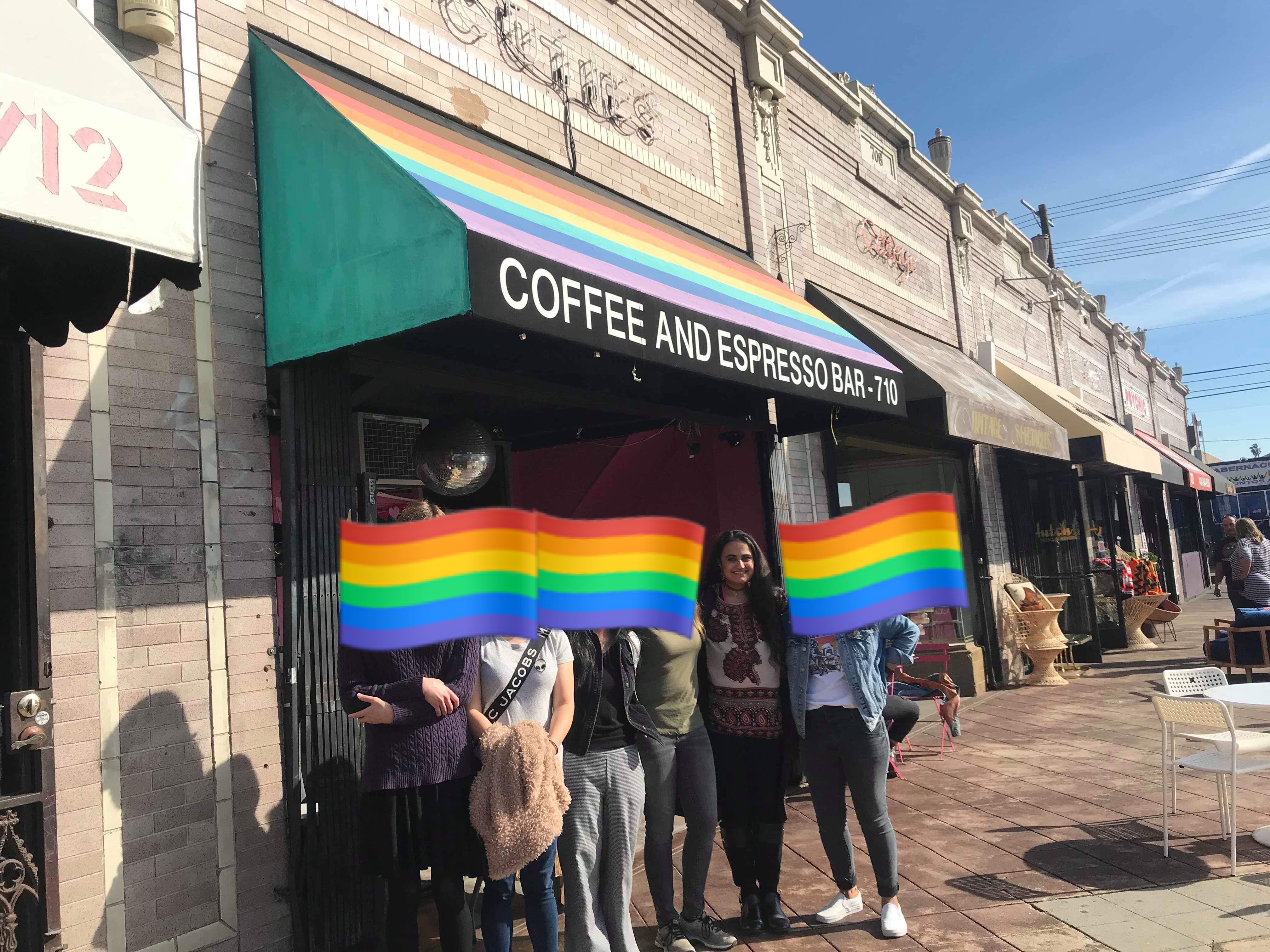
One of the social events in this club was a trip to Cuties Coffee, a queer owned and themed coffee shop in East Los Angeles that is designed to be a daytime, sober space for queer socialization and an alternative to the gay bars in West Hollywood. I loved visiting this place so much that I have now made it part of my weekend routine – I go there from around noon to four almost every Saturday to either study for classes or work on coding for research. I have included a picture from that day, and used the rainbow pride flag emojis to cover faces for the privacy of the other org members.

IMG_0079

I can’t stress how important it has been for me to have a queer sober space to go to, as I would say I’m pretty far on the introverted side of the spectrum and I never quite feel comfortable meeting new people in bars or nightclubs. (I still mostly keep to myself, drink my coffee/tea, and study during my trips to Cuties, but I hope I will cross the barrier of talking to strangers soon!). At the beginning of winter quarter, I went to West Hollywood a few times to check out the gay bars and nightclubs. Although I love walking on the main strip in West Hollywood, and enjoyed the experience to some extent, it’s not ideal for me because 1) the bars and clubs are largely catered towards gay men – Wednesdays are the only nights specifically for women, and there are no specific clubs for women, and 2) for some reason, being in these spaces where I’m (theoretically) approaching random strangers who are making snap judgments and impressions about me solely based on my physical appearance spiked some of my body insecurities, and to be honest, that’s not a headspace I want (or need) to be in. Right now, the focus for me is on meeting new queer friends and building community, and I’m grateful for these multiple sober spaces I have had access to this quarter.

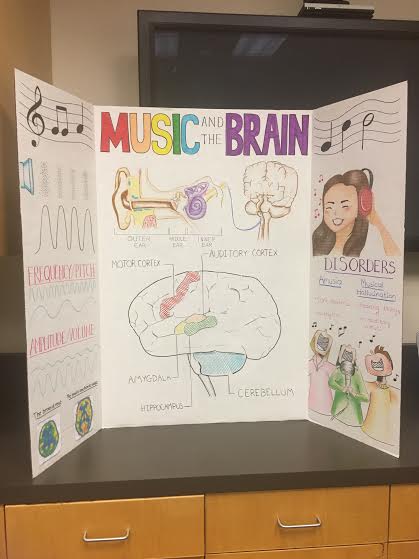
Another extracurricular activity I participated in this winter was a club that does educational outreach in the form of presenting posters about various neuroscience to elementary through high school students to get them excited about learning about the brain. I was part of this Committee called Project Glia, which is responsible for designing and creating posters. I really wanted a way to keep in touch with my art – it can be extremely cathartic and rewarding, and I also want to catch up on the neuroscience background I never had in undergrad for my research, so this was the perfect opportunity for me. I designed this poster for “Music and the Brain”, and I was working with two undergrads who did a lot of the neat typography and shading. The director of Project Glia is a senior undergrad who happens to be taking one of my current graduate neurosciences classes with me, The Biology of Learning and Memory.

0-2

One thing I found strange in participating in these activities is that sometimes the undergrads I interact with seem to look up to me in a way, or think that I know things because I am a grad student. One of the students was talking to me the other day about imposter syndrome and comparing yourself to other people, and I ended up saying something along the lines of “Oh, I totally understand that feeling because I used to do that too. But honestly, you can drive yourself crazy comparing yourself to other people – I know because I have done it too, but I realized it was no longer serving me, and I realized I don’t have to be this ‘star student’ to still enjoy what I’m doing.” “That’s SO true,” she had responded sincerely, and meanwhile I was internally panicking during this entire interaction. It was different than listening to a friend, someone who considers me a colleague, and I was suddenly aware of the power dynamic and how much responsibility I had. I think because I’m currently a woman in a grad school program in a related field, some of these women who have goals of grad or med school see me as a sort of safe person to vent to who knows what it’s like to go through this kind of application process and how demoralizing it can be. I was quite nervous about saying the right thing, and having the right mix of relatability and encouragement – all without sounding too preachy or pretentious. When I talked about this later at pub night later with a sixth-year in my program, someone who has significant teaching experience, he reiterated that I have the power to reduce these young women’s imposter syndrome in STEM simply by listening to them and encouraging them. Which is exciting, but also intimidating, because just a year ago, I was that undergrad.

Anyways, that is the (long-winded) gist of the updates of my grad school life over the past quarter. I have some ideas for future, more focused posts, but hope to update more often with these topics as they come up! Until then, I have an exam coming up in my cell neurobiology course, a data analysis assignment, and a research presentation coming up. Wish me luck!

Introduction

Hello to everyone reading this!

I am a first-year grad student in California, and I decided to create this blog to document some of my experiences on this path working towards becoming a scientist. I would like to use this page as a record of some of my ideas in research, as well as some personal reflections about research, classes, teaching experiences, social experiences, and pursuing hobbies.

My department, Biomathematics, is a small basic science research department within the school of medicine. It focuses on theoretical, computational, and statistical modeling in biology and biomedicine. My research interests are in neuroscience, and the project I have been starting to work on this year focuses on applying tools from physics and applied mathematics to model neuronal networks.

I started college as a chemistry major, but after a while, I realized that while I loved the theoretical side of chemistry, experiments were very much not my strong suit. I changed my major to mathematics/applied science, which allowed me to take theoretical chemistry classes along with a set of courses in applied mathematics. I have always found myself interested in neuroscience, and in my last two years of undergrad, I worked in a research group that studied neurons and neuronal networks from the perspective of theoretical biophysics. There, I picked up a lot of skills in programming and applied mathematics. More than anything, I learned how to find the background information I need for a given task, which has been tremendously helpful transitioning into graduate school. 

Aside from curiosity, my main motivation to study neuroscience comes from a desire to improve our understanding of the brain and mental health from a quantitative perspective. Mental health diagnoses are often based on self-reported qualitative data such as questionnaires, which are imprecise and very susceptible to bias. I believe that a greater understanding of the brain and cognitive processes from a theoretical perspective could not only better inform diagnosis and therapeutic intervention, but could reduce the stigma surrounding mental illness. Mental illnesses such as depression, anxiety, attention-deficit hyperactive disorder (ADHD), and obsessive-compulsive disorder (OCD) are often not taken as seriously as physical illness. As a result, many people suffer in silence and do not seek the treatment they need. A greater understanding of the mechanistic aspects of cognitive disorders is, I believe, a step towards recognizing the biological basis of mental illnesses and validating the health concerns of those affected. It motivates me to think about this as a long term goal, and that my studies in science are not only for my own benefit, but towards the benefit of society as a whole.

During my free time, I like finding content on the internet, in the form of blogs, art, and youtube videos. Since school is obviously a large part of my life, I like content about college and graduate school. I have found some content about life as a STEM student in graduate school, and I have felt a sense of inspiration and motivation from watching others working towards their research goals while simultaneously pursuing their hobbies. However, since my field, the interface between biology and mathematics, is relatively new, I rarely find content from students who are studying similar things that I can relate to. So I decided that if it doesn’t already exist, why not create it?

I believe it will be helpful for me to have a record of my progress in learning the material I need to know for my research, and writing things out in a pedagogical way would probably aid my own understanding of the things I’m learning. I also think that it will help me hold myself accountable, not only for my research progress, but also towards personal goals and hobbies, such as drawing and painting, swimming, dance, making new friends, and putting myself out there in the queer community.

It is likely that this blog will mostly be for my own record, and maybe some of my friends who might be interested in what I am doing. However, part of the reason I found it difficult to identify with other people in STEM is that I am often surrounded by peers who are very different from me. I have often benefitted from meeting other women, people of South Asian origin, and queer people in my field, and I know from my own experience how important representation is. I would love to know if anyone relates to any part of my experience, so please do not hesitate to contact me.

Here’s to a fruitful new year, and I am excited to begin this new journey.